
Why Size Matters: The Hidden Cost of Economically-Driven Schools
How micro-schools and relational learning environments outperform large institutions—and what your school can do about it

When we design schools, what comes first: the budget spreadsheet or the child?

For most educational systems (schooling) worldwide, the honest answer is uncomfortable. Large schools exist primarily because of economic calculations—state funding formulas, efficiency metrics, and administrative convenience. But mounting research reveals a troubling truth: what makes economic sense rarely makes educational sense.
The Efficiency Illusion
Walk into a typical large school and you’ll see the logic of economy of scale everywhere: one principal overseeing 800 students instead of four principals overseeing 200 each, shared facilities, bulk purchasing, standardized systems. On paper, it’s efficient.
In reality, it’s failing our children.
Recent research shows that beyond a certain threshold, schools don’t just lose their relational quality—they actively undermine learning and wellbeing (Alspaugh, 1994; Lee et al., 2019). Students become numbers. Teachers become deliverers of curriculum. Parents become peripheral. The very relationships that research identifies as foundational for student engagement, motivation, and academic success get sacrificed at the altar of administrative efficiency.
What Research Actually Tells Us About Learning
The evidence is unequivocal:
Strong, caring relationships between students, teachers, and families are the foundation of effective education (Evans et al., 2024; Miller, 2021; Onaga, 2022). Not a nice addition. Not a soft skill. The foundation.
Yet large, economically-driven schools systematically make these relationships nearly impossible:
Visibility disappears: In large classes and schools, individual students become invisible, participation declines, and support becomes generic rather than personalized (Wang & Calvano, 2022; Gravett & Winstone, 2020)
Community fractures: As schools grow, parent and student participation drops, and the sense of belonging—especially critical for marginalized students—evaporates (Alspaugh, 1994; Abacioglu et al., 2023)
Teachers burn out: When you’re managing 150+ students, building meaningful relationships isn’t just difficult—it’s mathematically impossible
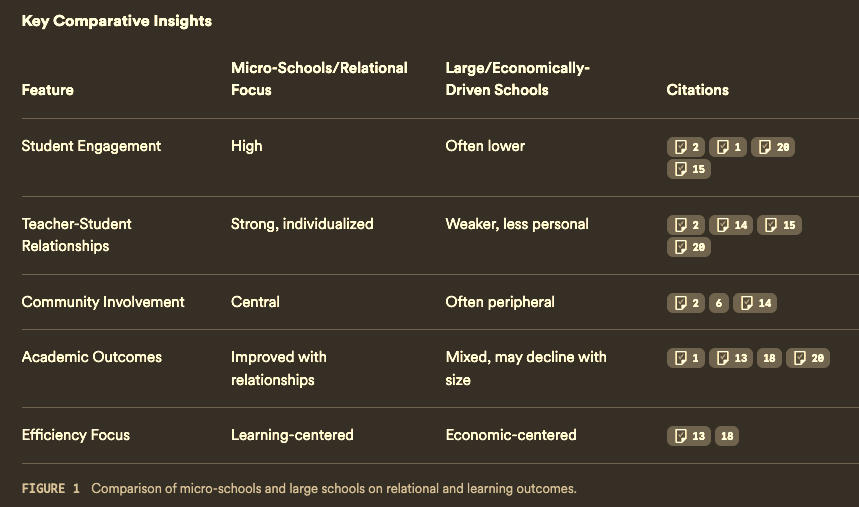
Meanwhile, micro-schools and small learning environments consistently demonstrate:
Higher student engagement and satisfaction
Stronger teacher-student relationships
More authentic community partnerships
Better academic outcomes, especially for disadvantaged students
Greater student agency and social awareness (Merino et al., 2025; Evans et al., 2024; Wang & Calvano, 2022)
The Question No One Wants to Ask
If we know that small, relational environments produce better outcomes, why do we keep building large schools? Because large schools are designed around what’s convenient for the system, not what’s effective for learning.
State funding formulas reward consolidation. Efficiency metrics prioritize cost-per-student over wellbeing-per-child. Administrative structures favor centralization over community responsiveness. The entire apparatus of modern education has been optimized for economic calculation, with learning and relationships treated as secondary concerns.
This is not a criticism of teachers or administrators—most are doing heroic work within impossible constraints. It’s a criticism of the fundamental design principles that govern our educational institutions.
A Different Way: Relational Learning at Any Scale
Here’s the paradox: while we can’t all build micro-schools overnight, we can embed micro-school principles into existing structures.
At Unmute Learning, we work with schools of all sizes to rebuild the relational foundation that large-scale systems have eroded. Our approach isn’t about romantic notions of small schoolhouses—it’s about applying evidence-based practices that research shows actually work:
1. Circle Practice: Democracy in Action
Circles create the small-group dynamics that research shows are critical for engagement and belonging—even within large schools. When students sit in circles for regular check-ins, conflict resolution, and decision-making:
Everyone becomes visible
Every voice matters
Relationships deepen through consistent, meaningful interaction
Students learn democratic participation through practice, not lecture
Our circle practice training equips teachers with facilitation skills to create these relational spaces authentically, managing power dynamics and building trust in ways that transform classroom culture.
2. Participatory Governance: Giving Students Real Voice
Large schools often justify their hierarchical structures as necessary for order. But research shows the opposite: students thrive when given genuine agency (Merino et al., 2025; Evans et al., 2024).
Participatory governance—where students co-create rules, make decisions about their learning environment, and take responsibility for community wellbeing—isn’t chaos. It’s structure built on trust rather than control.
Our participatory governance consultancy helps schools:
Design decision-making processes that authentically include student voice
Navigate the messy reality of shared power
Build systems that distribute authority without losing coherence
Train staff to facilitate rather than dictate
3. School Wellbeing: The Community-Focused Approach
The research is clear: wellbeing isn’t a program you add—it’s the result of relational quality throughout the school (Vaillancourt et al., 2021; Evans et al., 2024).
Schools that prioritize an “ethic of care” and person-centered approaches see measurable improvements in:
Student engagement and attendance
Academic outcomes
Social-emotional development
Family involvement
Teacher retention
Our school wellbeing consultancy works holistically:
Assessing relational quality across all stakeholder groups
Identifying where economic-driven structures undermine wellbeing
Co-designing community-centered practices that fit your context
Building capacity for sustained, authentic care
The Choice Ahead
We face a choice about what we’re optimizing for: spreadsheets or children.

The economic argument for large schools has always been weak—research shows efficiency gains plateau and even reverse beyond certain sizes (Alspaugh, 1994; Lee et al., 2019). But more fundamentally, it’s the wrong question.
Education isn’t a manufacturing process where we should minimize cost-per-unit. It’s a relational endeavor where the “product” is human flourishing. And human flourishing happens in relationships—the very thing our economically-driven systems have systematically dismantled.
You can’t budget your way to belonging. You can’t economize connection. You can’t efficiency-engineer trust.
What One Democratic Education Participant Said
“I learned that power, trust, and collaboration in education mean working with students rather than above them. I don’t have all the answers, and real learning happens when I trust my students and collaborate with them.”
This isn’t soft pedagogy. This is what 100% of participants in our recent democratic education course identified as transformative—and it’s what research shows actually works.
Ready to Prioritize Relationships?
Whether you lead a large institution or a small learning community, the question is the same: Are your structures serving learning, or is learning serving your structures?
Unmute Learning offers:
Circle Practice Training: Build relational capacity through democratic dialogue
Participatory Governance Consultancy: Design systems where student voice drives decisions
School Wellbeing Assessment & Strategy: Shift from programs to culture
Democratic Education Courses: Transform your understanding of power, trust, and learning
We work with schools that are ready to ask difficult questions about their own design—and brave enough to change what they find.
Let’s Talk
If you’re tired of watching economic calculations override educational wisdom, let’s have a conversation about what relational learning could look like in your context.
Contact Unmute Learning
Because the best school size isn’t determined by a funding formula—it’s determined by whether every child is known, heard, and valued.
Charlie Moreno-Romero, Ph.D
Unmute Learning CEO
References
Abacioglu, C., Epskamp, S., Fischer, A., & Volman, M. (2023). Effects of multicultural education on student engagement in low- and high-concentration classrooms: the mediating role of student relationships. Learning Environments Research, 26, 951 - 975. https://doi.org/10.1007/s10984-023-09462-0
Evans, C., Welton, N., Pitman, J., Clegg, Z., & Williams, D. (2024). An ethic of care in two community focused schools in Wales. Research Papers in Education, 40, 281 - 298. https://doi.org/10.1080/02671522.2024.2381114
Merino, I., Membrive, A., Largo, M., & Engel, A. (2025). School projects with the community: Educational practices that promote connection between learning contexts and experiences.. Acta psychologica, 255, 104893. https://doi.org/10.1016/j.actpsy.2025.104893
Gravett, K., & Winstone, N. (2020). Making connections: authenticity and alienation within students’ relationships in higher education. Higher Education Research & Development, 41, 360 - 374. https://doi.org/10.1080/07294360.2020.1842335
Lee, B., Worthington, A., & Wilson, C. (2019). Learning environment and primary school efficiency. International Journal of Educational Management. https://doi.org/10.1108/ijem-05-2017-0103
Onaga, F. (2022). RELATIONAL STRATEGIES IN THE SCHOOL SETTING – SPECIFIC FEATURES IN PRIMARY EDUCATION. Journal of Pedagogy - Revista de Pedagogie. https://doi.org/10.26755/revped/2022.1/105
Miller, K. (2021). A Light in Students’ Lives: K-12 Teachers’ Experiences (Re)Building Caring Relationships During Remote Learning. Online Learning. https://doi.org/10.24059/olj.v25i1.2486
Vaillancourt, T., McDougall, P., Comeau, J., & Finn, C. (2021). COVID-19 school closures and social isolation in children and youth: prioritizing relationships in education. FACETS. https://doi.org/10.1139/facets-2021-0080
Alspaugh, J. (1994). The relationship between school size, student teacher ratio and school efficiency. Education 3-13, 114, 593-602.
Wang, L., & Calvano, L. (2022). Class size, student behaviors and educational outcomes. Organization Management Journal. https://doi.org/10.1108/omj-01-2021-1139
Want more insights on democratic education, participatory learning, and relational pedagogy? Subscribe to Unmute Learning’s newsletter for research-backed strategies that actually work.
This article comes at the perfect time; thank you for brilliantly artikulating how our education systems too often prioritise spreadsheets over actual human growth, making the 'efficiency illusion' a brutal bug.